Barn Record Enfield
RETURN TO ‘FIND BARNS’- Building Name (Common)
- FRW Tobacco Shed 14 - Part - 2/2
- Building Name (Historic)
- FRW Tobacco Shed 14
- Address
- 119 Moody Road, Enfield
- Typology

- Overview
-
Designations
n/a
Historic Significance
Architectural Description:
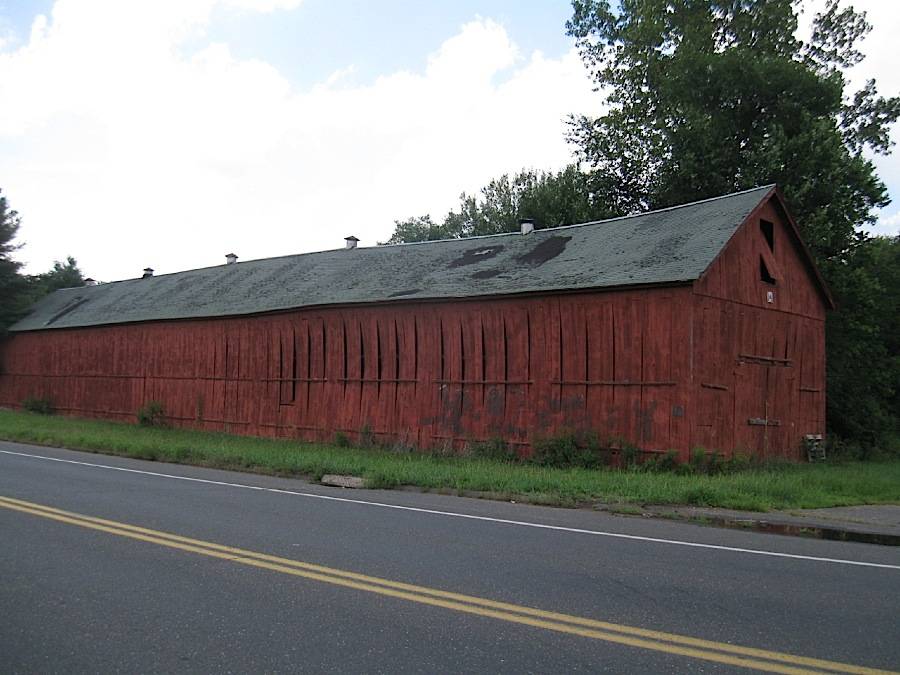
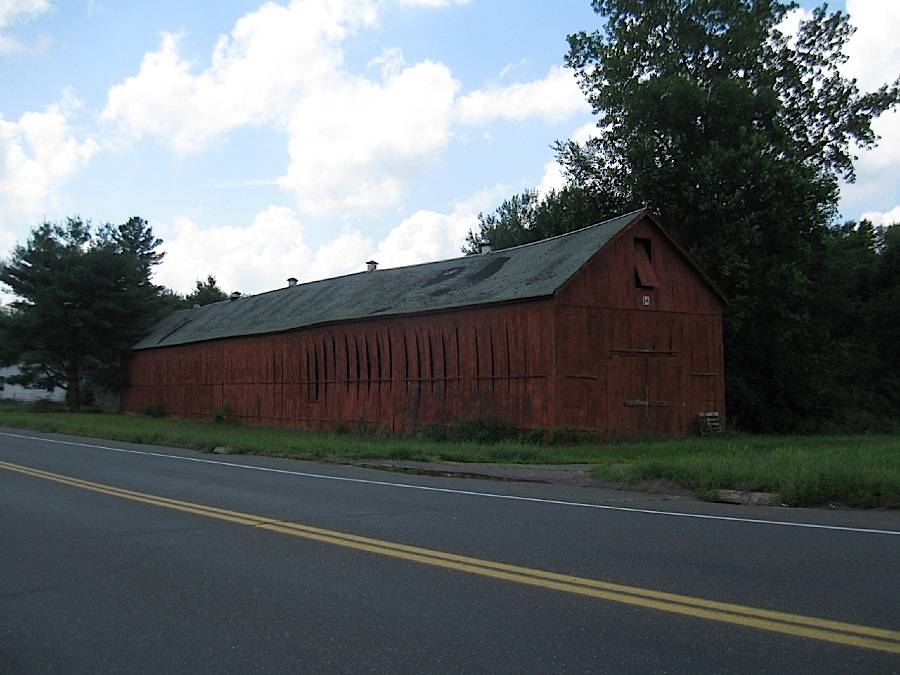
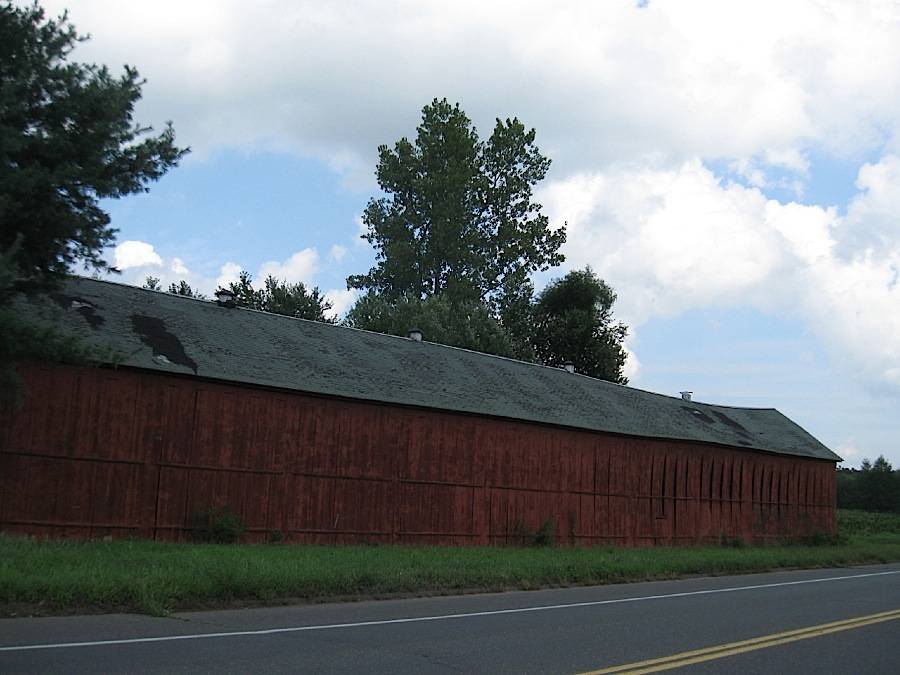
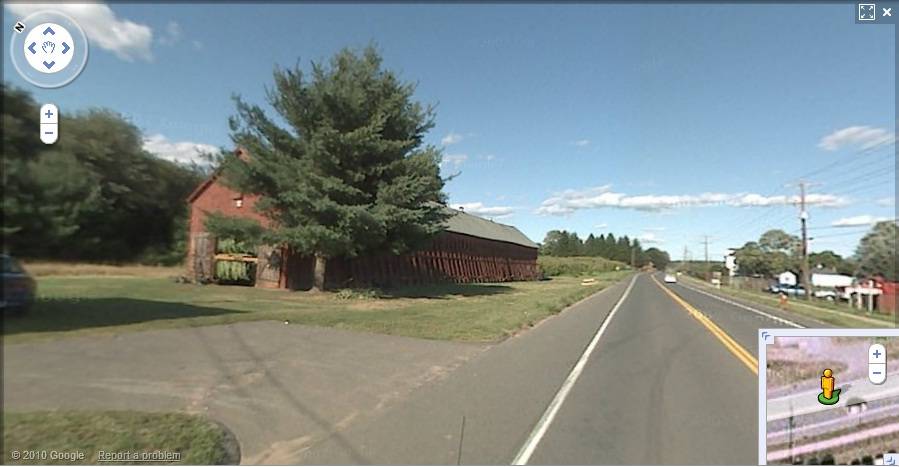
This is a 1 1/2 - story three-aisle twelve-bent gable-entry tobacco shed. The south eave-side of the tobacco shed faces Moody Road while the ridge line runs east-west parallel to the road. The main façade of the tobacco shed is the west gable-façade with the main entrance at the center through a pair of Z-braced hinged wagon doors. The tobacco shed is ventilated through the vertical siding on the eave-sides where every second board is hinged at the top and tilted out at the bottom by means of a horizontal cleat, that lifts many boards at once, and metal prop hooks to hold the boards in place. The shed has additional roof ventilation through five metal ventilators lined along the ridge of the gable roof.
The wooden frame of the tobacco shed has red painted vertical siding walls and asphalt shingle roofing.
Historical Significance:The tobacco barn, or shed as it is called in the Connecticut River Valley, is one of the most distinctive of the single-crop barns. They tend to be long, low windowless buildings with pitched roofs. They are characterized by vented sides to regulate air flow and allow harvested tobacco to cure at the appropriate rate. Derived initially from the design of the English barn, the shed is composed of a fixed skeleton consisting of two- or three-aisle bents repeated at intervals of 15 feet to the desired length. The wood-framed bents sit on piers of stone or concrete and the bents are connected by girts and diagonal braces. Typically there are two doors at each end, making the shed a “drive-through,” although some sheds are accessed through doors on the sides. The interior structural framework serves a second purpose in addition to supporting the walls and roof of the building; it provides a framework for the rails used to hang the tobacco as it cures.
This is accomplished with one of four different systems (more than one method may be utilized in a single shed):
a) Vertical siding in which every second board is hinged at the top and tilted out at the bottom by means of a horizontal cleat, that lifts many boards at once, and metal prop hooks to hold the boards in place;
b) Vertical siding in which alternate boards are hinged along the sides to open like tall narrow doors;
c) Less commonly, horizontal siding in which alternate boards are hinged along the top edge and open like long narrow awnings;
d) A series of large doors along one of the long sides of the building with the other sides of the building vented by one or more of the other methods.Field Notes
Also See Part – 1/2 http://www.connecticutbarns.org/index.cgi/8019
- Use & Accessibility
- Environment
Related features
Environment features
Relationship to surroundings
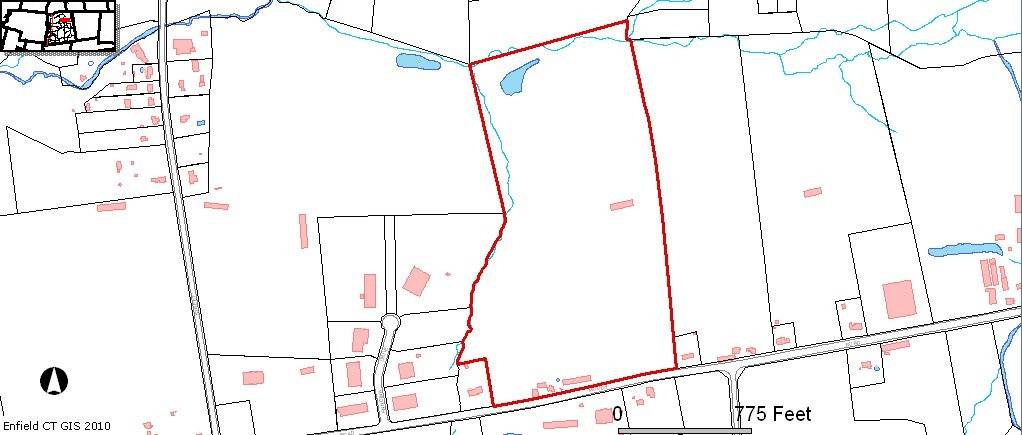
The 46 acres property, Map 93, is towards the north of Moody Road in a mixed land use area designated as Shaker Pines Fire District. The property is surrounded by active farm land towards the west and the south while Enrico Fermi High School is situated towards the southeast, across Moody Road.
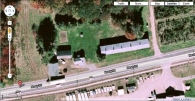
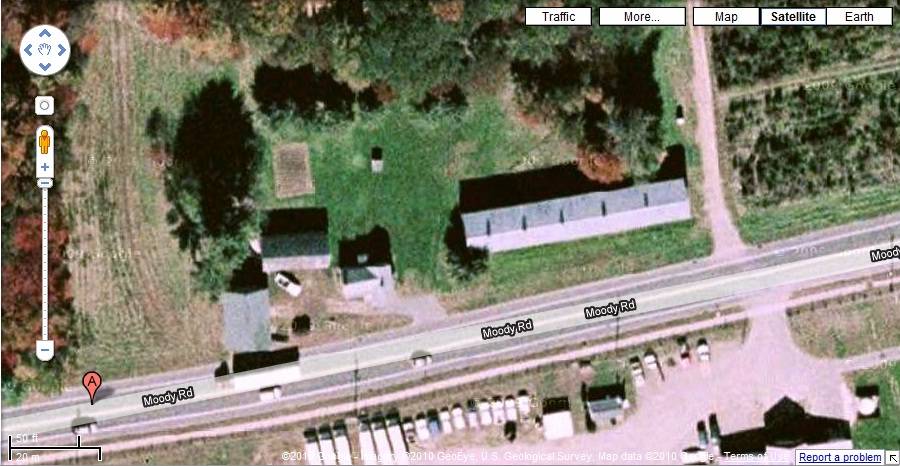
The tobacco shed is towards the southern edge of the property abutting to Moody Road. A U-shaped building complex can be seen towards the west of the shed. A 1 ½ - story English barn, http://www.connecticutbarns.org/index.cgi/8019
, and the circa 1900 main residence form the two arms of the U-shaped complex while the base is formed by another 1 ½ story eave-entry gable-roof barn. Parcels of farm land with active agriculture can be seen towards the east and the west of this building complex while dense woodland can be seen towards the north.- Typology & Materials
-
Building Typology
Materials
Structural System
Roof materials
Roof type
Approximate Dimensions
n/a
- Source
-
Date Compiled
09/01/2010
Compiled By
T. Levine and M. Patnaik, reviewed by CT Trust
Sources
Photographs and field-notes provided by –
Gretchen Pfeifer-Hall, gretchenph@snet.netAssessors’ records information retrieved on September 1st, 2010 from website http://www.enfield-ct.gov/
Aerial photograph/Information retrieved on September 1st, 2010 from website http://www.google.com/
Sexton, James, PhD; Survey Narrative of the Connecticut Barn, Connecticut Trust for Historic Preservation, Hamden, CT, 2005, http://www.connecticutbarns.org/history.
Visser, Thomas D.,Field Guide to New England Barns and Farm Buildings, University Press of New England, 1997.
- PhotosClick on image to view full file
-