Barn Record Durham
RETURN TO ‘FIND BARNS’- Building Name (Common)
- n/a
- Building Name (Historic)
- n/a
- Address
- 86 South End Avenue, Durham
- Typology

- Overview
-
Designations
n/a
Historic Significance
Architectural description:
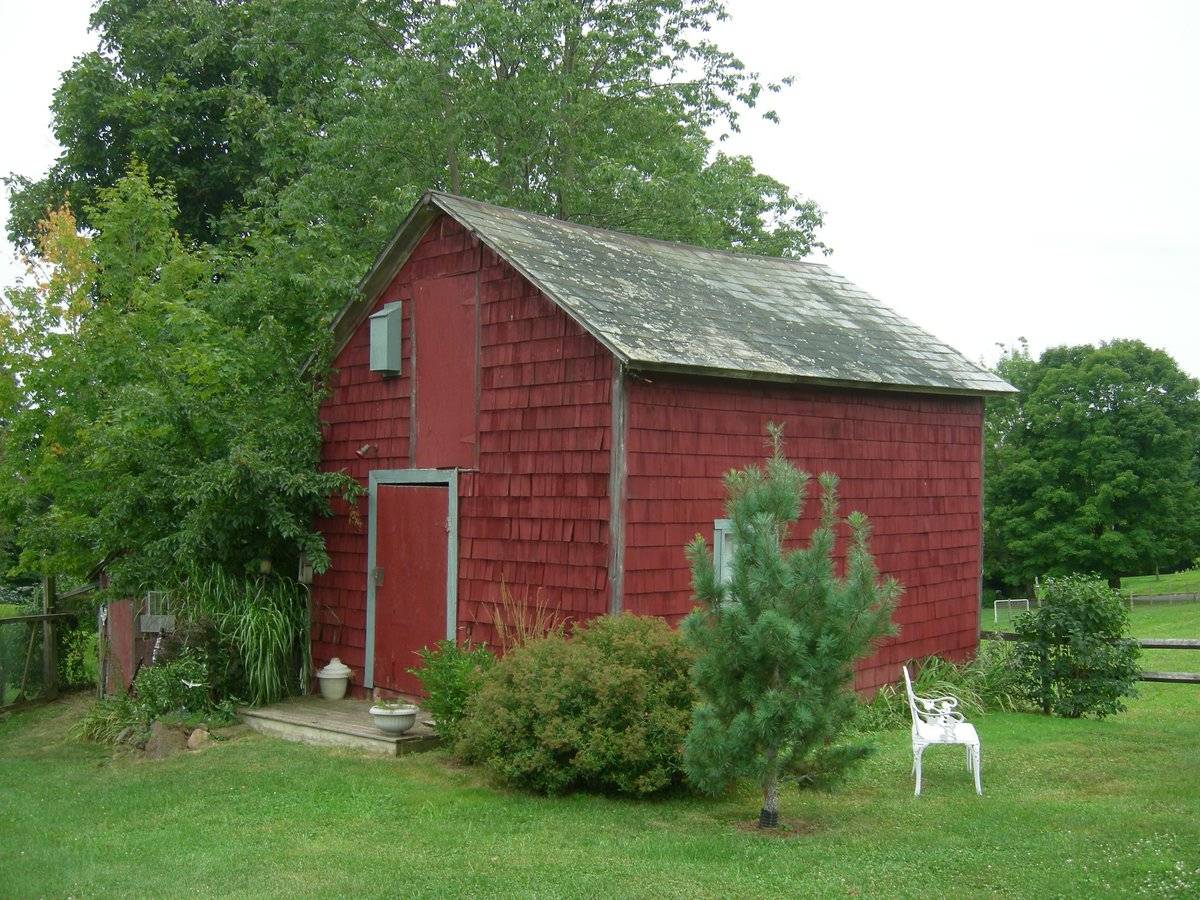
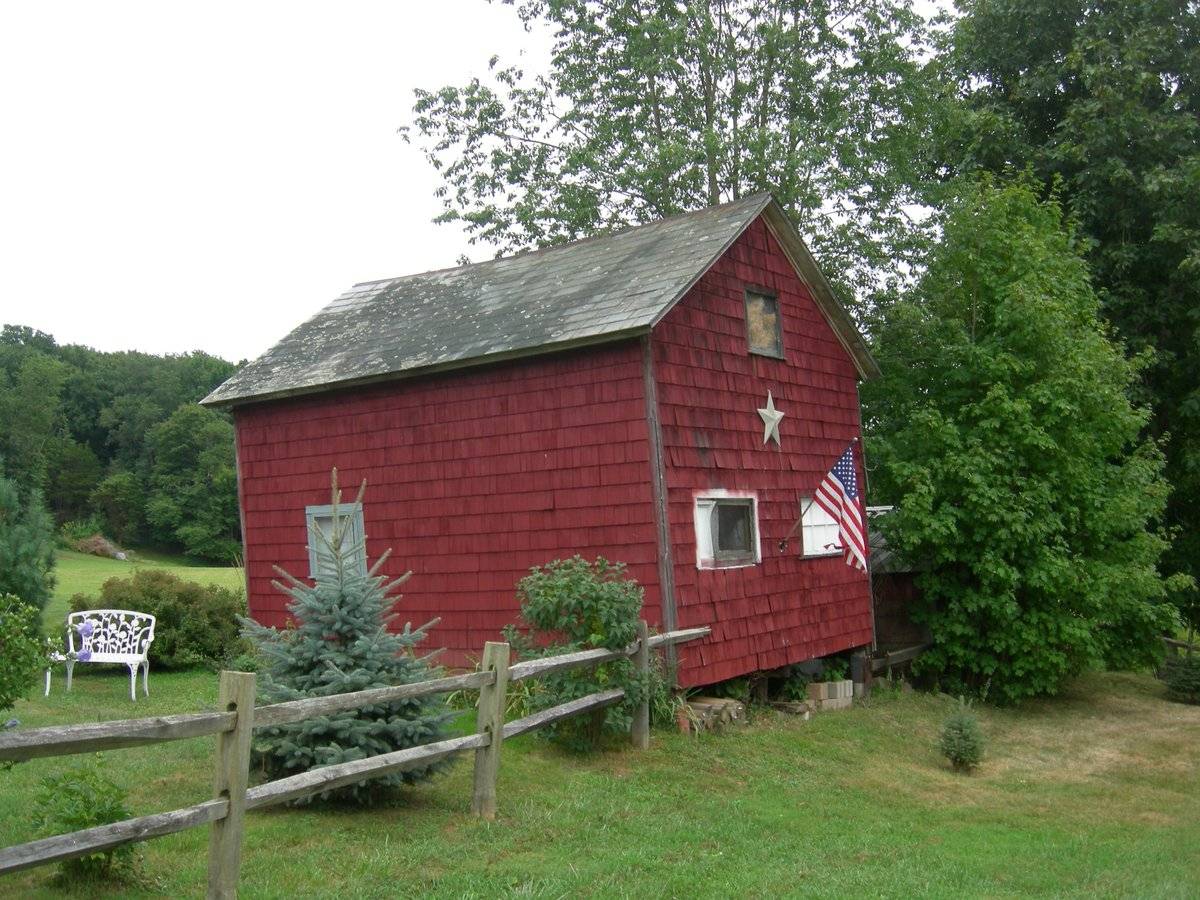
This is a 1 ½-story gable-roofed, gable-entry barn. The main facade faces east and the ridge-line of the barn runs perpendicular to South End Avenue, which runs approximate north-south. The main entry is slightly off-center towards the south of the east gable-end of the barn and is a hinged pass-through door with gray trim. Above the entry, centered in the gable-attic under the apex of the roof is a hay door with wrought iron hinges. The south eave-side of the barn appears to have a window towards the southwest corner. There is another gable-roof barn built south of the main barn that is obstructing the view. All that can be seen of this barn is that there is a pass-through door towards the southeast corner and a window just north of the entrance with six-panes and a flower box. The ridge-line of the second barn is parallel to the main barn. The west gable-end of the main barn has two windows evenly spaced along the main level. It can be seen that the window towards the southwest corner has six-panes. There is a square window in the gable-attic centered below the apex of the roof, which is boarded up. The north eave-side of the barn is blank except for a single-pane window towards the northeast corner. The barn is clad in wood shingles painted red. The roof has projecting eaves and is clad in asphalt shingles.
Historical significance:The oldest barns still found in the state are called the “English Barn,” “side-entry barn,” “eave entry,” or a 30 x 40. They are simple buildings with rectangular plan, pitched gable roof, and a door or doors located on one or both of the “eave” sides of the building based on the grain warehouses of the English colonists’ homeland. The New England barn or gable front barn was the successor to the English barn and relies on a gable entry rather than an entry under the eaves. The gable front offers many practical advantages. Roofs drain off the side, rather than flooding the dooryard. Although it was seen by many as an improvement over the earlier side entry English Barn, the New England barn did not replace its predecessor but rather coexisted with it. It this case, both an eave entry and a gable entry are used.
Historical background:Geographical constraints, as well as advantages, and a particularly heterogeneous settlement population drawn from all over the Connecticut Colony, were some of the factors that shaped the course of Durham’s history, transforming the town from a self-sufficient farming village into a relatively cosmopolitan center of commercial agriculture and small-scale, agrarian-based industry.
Prior to settlement the Town of Durham was known as the Coginchaug, or Great Swamp. Most of the land in the town had been granted to individuals for distinguished service to the colony in military or civic affairs in the seventeenth century. All of these men were absentee owners; none were anxious to occupy what was then one of the least desirable areas for settlement in the colony. Swamp and marshland occupied most of the central part of the area, surrounded by rolling hills overlaying rocky ledges. Less than one third of the mere 15,000 acres was suitable for cultivation.
Field Notes
There appears to be a potato barn to the north of this small barn. A farm pond is to the east.
- Use & Accessibility
Use (Historic)
Use (Present)
Exterior Visible from Public Road?
Yes
Demolished
n/a
Location Integrity
Unknown
- Environment
Related features
Environment features
Relationship to surroundings
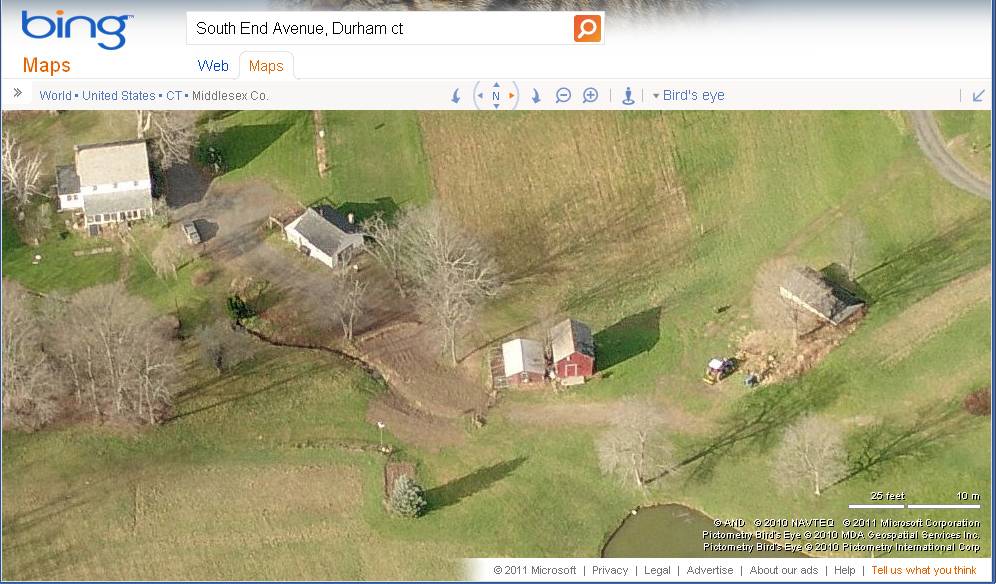
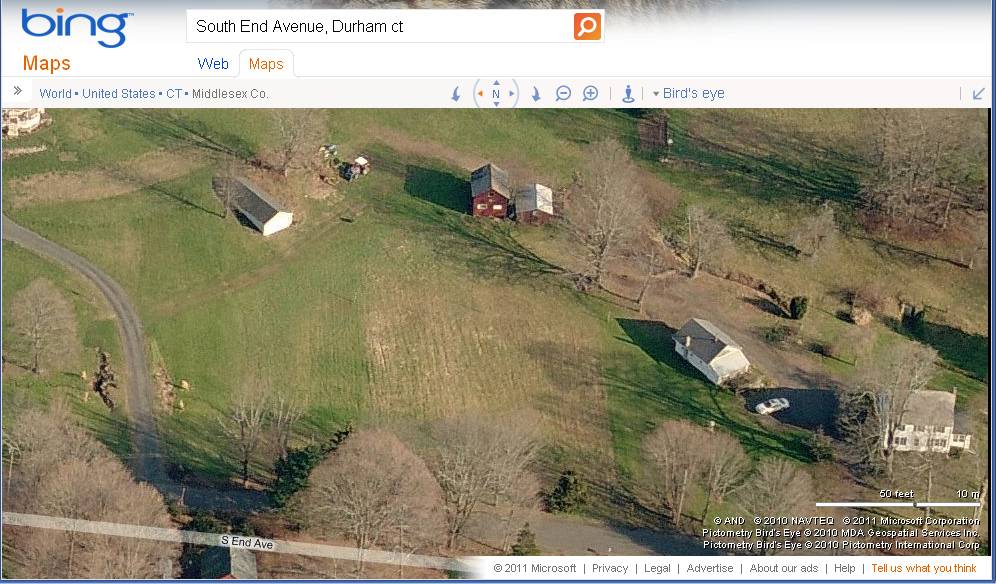
The barn is located behind and to the north of the c. 1936 house it is associated with. The ridge-line of the barn is perpendicular to the ridge-line of the house. There is another structure located directly south of the barn. To the north is open land with some scattered trees and rocks, to the east is a small pond and open land, to the south there are scattered trees, and to the west there are scattered trees and open land. The total size of the property is 2.01 acres. Surrounding the site is woodland, open land and residential. The property is located 0.9 miles south of Durham, the nearest major town center.
- Typology & Materials
-
Building Typology
Materials
Structural System
Roof materials
Roof type
Approximate Dimensions
n/a
- Source
-
Date Compiled
02/14/2011
Compiled By
R. Parris & T. Levine; reviewed by CT Trust
Sources
Field notes and photographs by Jim McLaughlin date 8/31/2010.
Town of Durham Assessor’s Record or GIS Viewer http://durham.univers-clt.com/view_property_R.php?account_no=S0227200&series_card=1
Parcel ID: S0227200
Aerial Mapping:
http://www.bing.com/maps accessed 02/14/2010.Cunningham, Jan, Main Street Historic District Nomination No. 86002837, National Park Service, 1986.
Sexton, James, PhD, Survey Narrative of the Connecticut Barn, Connecticut Trust for Historic Preservation, Hamden, CT, 2005, http://www.connecticutbarns.org/history.
Visser, Thomas D., Field Guide to New England Barns and Farm Buildings, University Press of New England, 1997. - PhotosClick on image to view full file
-