Barn Record Columbia
RETURN TO ‘FIND BARNS’- Building Name (Common)
- n/a
- Building Name (Historic)
- n/a
- Address
- 122 Lake Road, Columbia
- Typology

- Overview
-
Designations
n/a
Historic Significance
Architectural description:
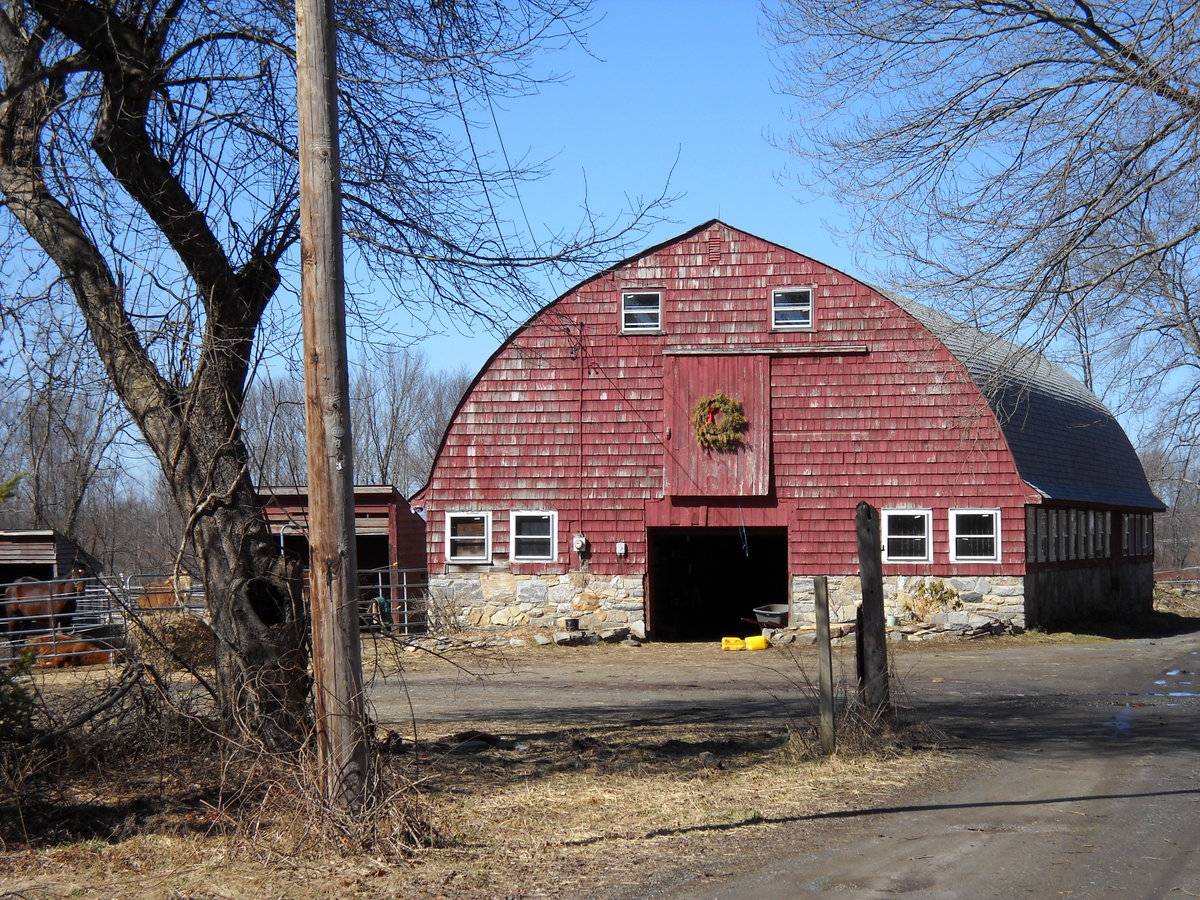
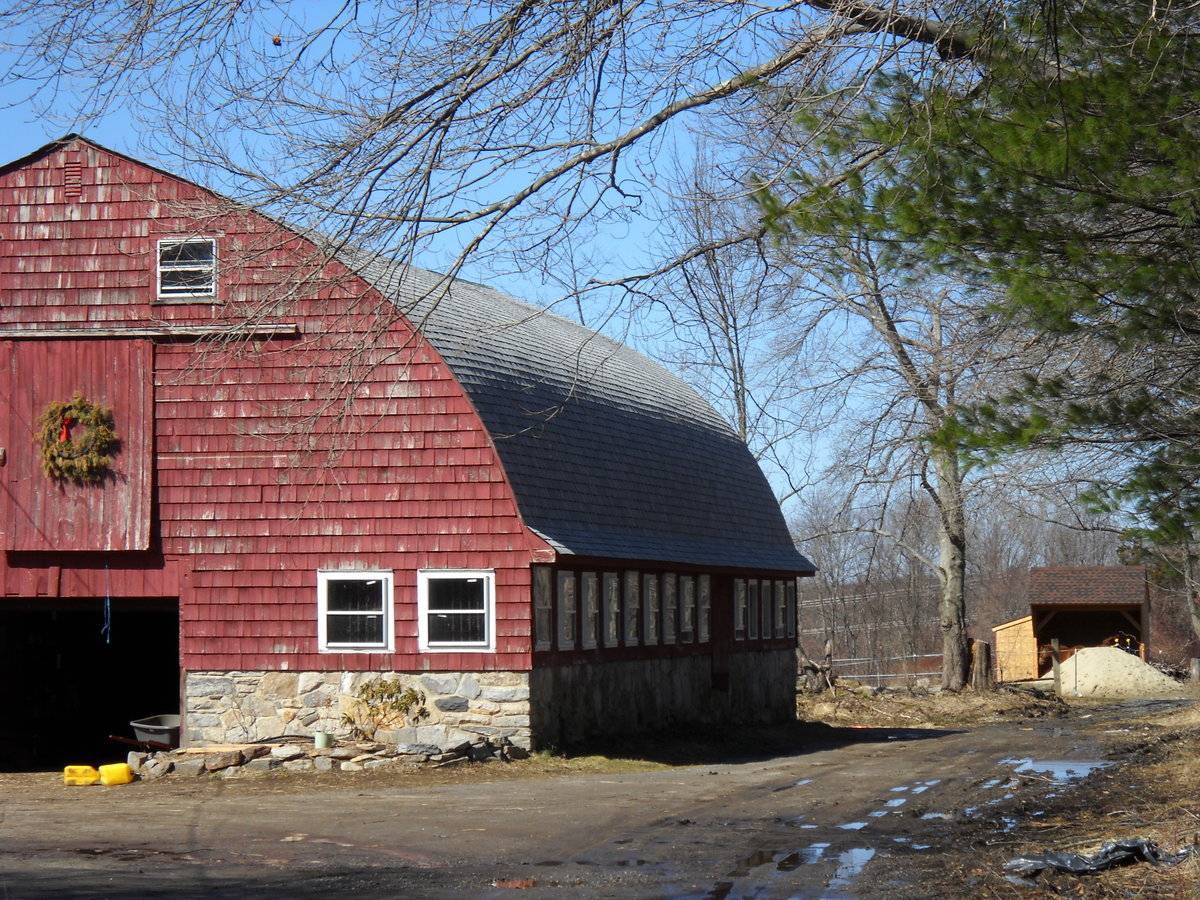
This is a 2 story Dutch gambrel-roofed gable entry barn. The main facade faces south and its ridge-line is perpendicular to this portion of Lake Road, which runs approximately east-west. The main entry is a wagon opening with no apparent door, centered in the south gable-facade. Flanking the opening are a set of two one-over-one windows above an exposed mortared field-stone foundation. Above the wagon opening on the second level is an exterior sliding hay door, with its track extending to the east. Beneath the apex of the roof is a louvered vent. Just below are two widely spaced one-over-one windows. The east eave-facade of the barn has a series of one-over-one windows spanning the entire length of the main level of the facade. The west eave-facade is identical except it also has a pass-through door towards the north corner. The north gable-facade appears identical to the south main gable-facade, except the wagon door is in place. The barn has wood shingles painted red and a mortared field-stone foundation. The asphalt shingled Gothic roof is Dutch influenced flairs.
Historical significance:By the early 20th century agricultural engineers developed a new approach to dairy barn design: the ground-level stable barn, to reduce the spread of tuberculosis bacteria by improving ventilation, lighting, and reducing the airborne dust of manure. A concrete slab typically serves as the floor for the cow stables. Many farmers converted manure basements in older barns into ground-level stables with concrete floors. Some older barns were jacked up and set on new first stories to allow sufficient headroom. With the stables occupying the entire first story, the space above serves a a hayloft. By the 1920s most ground-level stable barns were being constructed with lightweight balloon frames using two-by-fours or two-by-sixes for most of the timbers. Tongue-and-groove beveled siding is common on the walls, although asbestos cement shingles also were a popular sheathing. Some barns have concrete for the first-story walls, either poured in place or built up out of blocks. The gambrel roof design was universally accepted as it enclosed a much greater volume than a gable roof did, and its shape could be formed with trusses.
Field Notes
Old red barn set way in back of house in field.
- Use & Accessibility
Use (Historic)
Use (Present)
Exterior Visible from Public Road?
Yes
Demolished
n/a
Location Integrity
Unknown
- Environment
Related features
Environment features
Relationship to surroundings
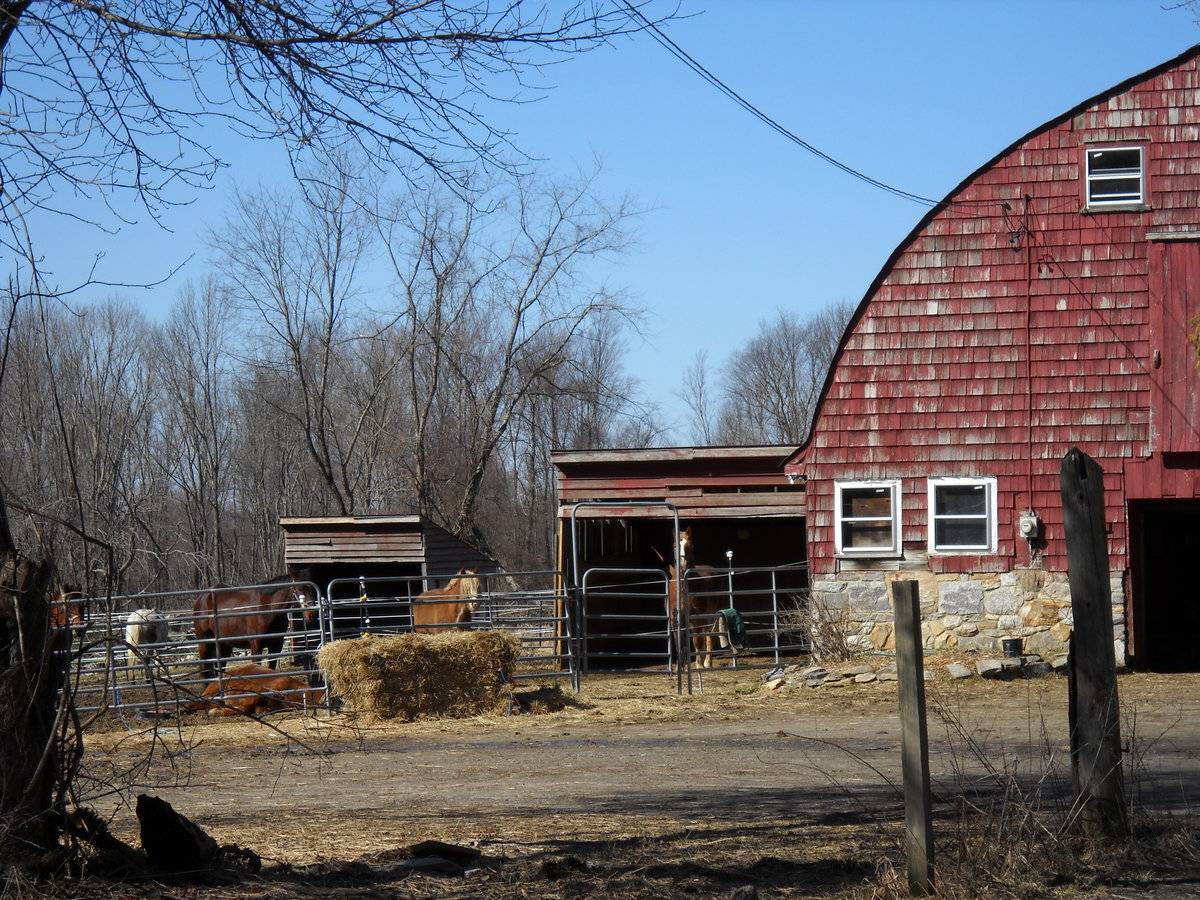
The barn is behind and to the northeast of the house and garage it is associated with. The ridge-line of the house is perpendicular to the barn and parallel to West road, running east-west. To the west of the barn is a couple of small sheds and three paddocks with metal fences. To the northeast of the barn is a tract of open space. The total size of the site is 2.01 acres. The area is residential, light agriculture, open space and woodland.
M/P = 026//003
- Typology & Materials
-
Building Typology
Materials
Structural System
n/a
Roof materials
Roof type
Approximate Dimensions
700 S.F.
- Source
-
Date Compiled
07/31/2010
Compiled By
Todd Levine, reviewed by the Connecticut Trust
Sources
Photographs and field notes by Janice Thibodeau.
Sexton, James, PhD; Survey Narrative of the Connecticut Barn, Connecticut Trust for Historic Preservation, Hamden, CT, 2005, http://www.connecticutbarns.org/history.
Visser, Thomas D.,Field Guide to New England Barns and Farm Buildings, University Press of New England, 1997.
Map of the Columbia, CT, retrieved on July 31, 2010 from website www.zillow.com.
Town of Columbia assessors office, 323 Route 87, Columbia, CT 06237.
- PhotosClick on image to view full file
-