Barn Record Stafford
RETURN TO ‘FIND BARNS’- Building Name (Common)
- n/a
- Building Name (Historic)
- n/a
- Address
- 9 Leonard Road, Stafford
- Typology
- Overview
-
Designations
Historic Significance
Architectural description:
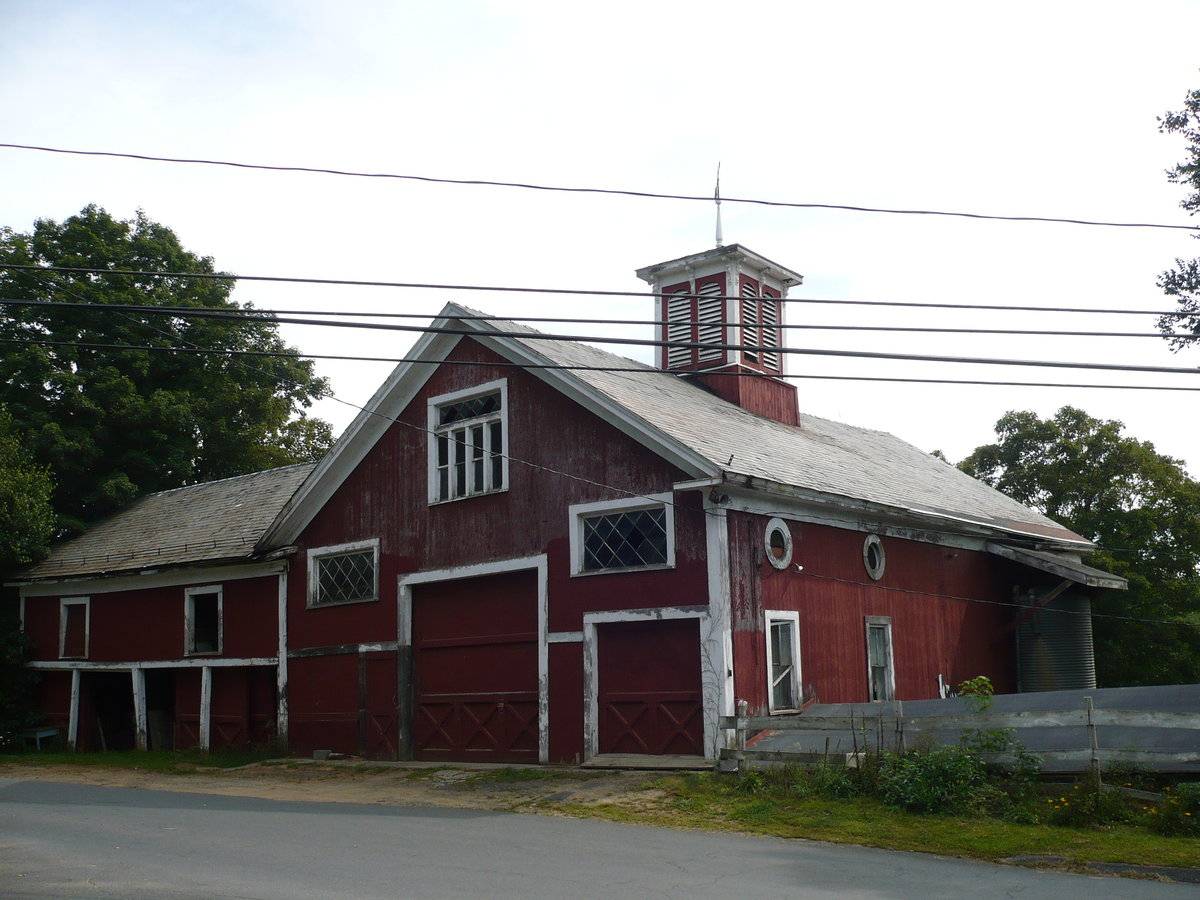
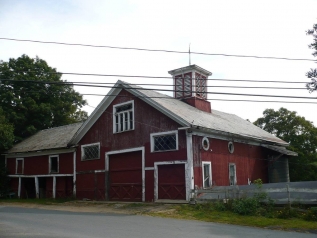
This is a 1 1/2 story Greek Revival gable-entry barn with a shed-roofed addition. The main facade faces Upper Road, which runs approximately southwest-northeast. This west facade has an interior sliding door in the center, flanked by a smaller interior sliding door to the south and a pass-through door to the north. Flanking the middle sliding door, just below the eave-line, are a pair of diamond-pane windows. Below the apex of the roof is an interesting window set-up: within a square frame are four one-over-one double hung windows under a diamond-pane window. The projecting overhang is boxed. The south eave facade has a pair of round windows just beneath the eave, both towards the western end of the facade towards the road. Beneath each is a two-over-two double hung window. The eastern portion of the facade has a hooded metal cylinder, perhaps a small silo. The north eave facade has a shed-roofed addition, with four bays. Above the middle two bays are hay doors. The roof is slate and has a large cupola. The barn and addition have vertical boards painted red with white trim.
Historical significance:The first popular Romantic style, Greek Revival, dominated the newly independent United States through much of the first half of the 19th century. Architectural models evocative of Greek democracy were thought to be especially appropriate in the new republic, as it rejected traditional ties to England in the decades following the War of 1812.
The New England barn or gable front barn was the successor to the English barn and relies on a gable entry rather than an entry under the eaves. The gable front offers many practical advantages. Roofs drain off the side, rather than flooding the dooryard. With the main drive floor running parallel to the ridge, the size of the barn could be increased to accommodate larger herds by adding additional bays to the rear gable end. Although it was seen by many as an improvement over the earlier side-entry English Barn, the New England barn did not replace its predecessor but rather coexisted with it.
The first ventilators were simple wooden louvered boxes with gable roofs, mounted near the ridge of the barn. The successor to the ventilator was the more romantic cupola. Coinciding with the Italianate style of domestic architecture popular during the mid-nineteenth century, the room-sized cupola, embellished with decorative brackets and a copper weathervane, became a symbol of modern farming during the early Victorian era. The object of the cupola is to protect the opening of the flue from the elements, keep out birds, prevent back drafts as far as possible, and assist in drawing the foul air from the barn. The cupola was replaced in the early twentieth century by the factory-produced steel ventilator, symbolizing another step in the movement towards an industrial approach to farming.
Field Notes
An elegant NE barn with cupola, slate roof, ornamental diamond paned and round upper level windows. Seriously deteriorated. Attached carriage shed on left side. The address is listed as a contributing resource in the Stafford Hollow Historic National Register for Historic Places District.
- Use & Accessibility
Use (Historic)
Use (Present)
Exterior Visible from Public Road?
Yes
Demolished
n/a
Location Integrity
Unknown
- Environment
Related features
Environment features
Relationship to surroundings
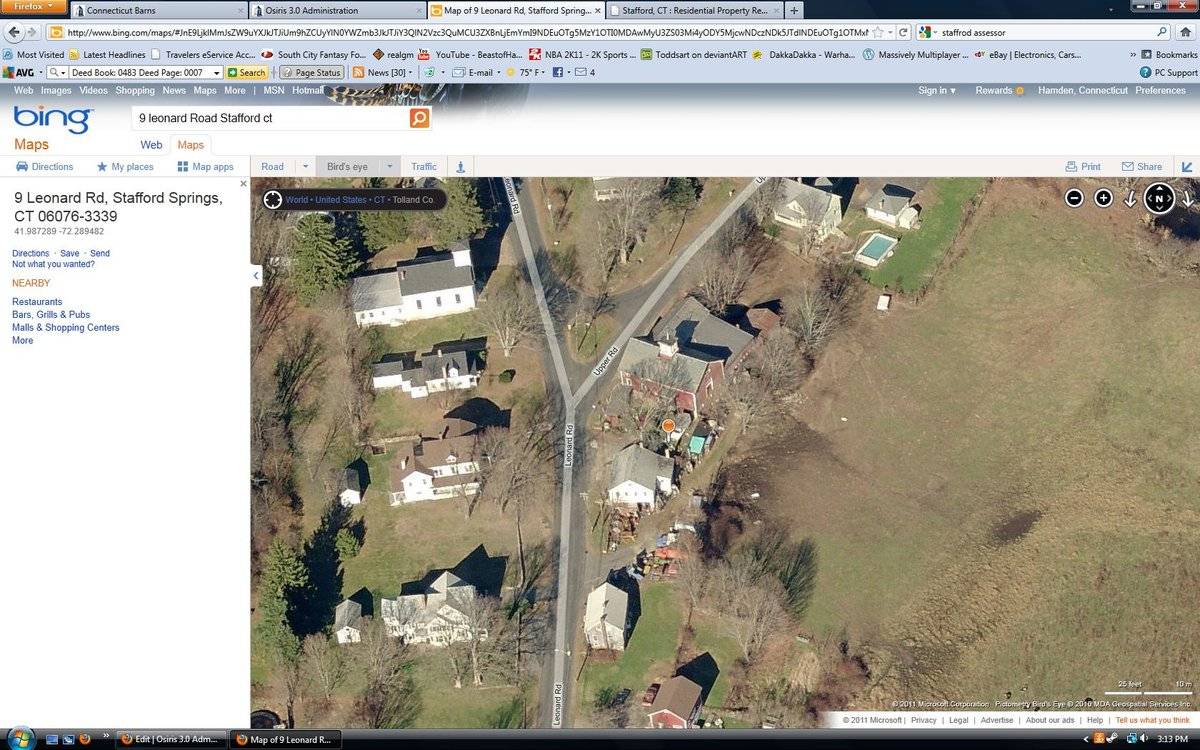
The barn sits alone on this 6.5 acre parcel except for a three bay garage just to its south, at the intersection of Upper Road and Leonard Road. To the east of the barn is a tract of land demarcated to the south and east by water; the north is demarcated by a stone wall and fence. The area surrounding the site is active agriculture, open space, residential and woodland.
- Typology & Materials
-
Building Typology
Materials
Structural System
Roof materials
Roof type
Approximate Dimensions
n/a
- Source
-
Date Compiled
11/20/2009
Compiled By
Todd Levine, reviewed by the Connecticut Trust
Sources
Photographs and field notes by P. Portier - 09/15/2009
Sexton, James, PhD; Survey Narrative of the Connecticut Barn, Connecticut Trust for Historic Preservation, Hamden, CT, 2005, http://www.connecticutbarns.org/history.
Visser, Thomas D.,Field Guide to New England Barns and Farm Buildings, University Press of New England,1997.
McAlester, Virginia & Lee, A Field Guide to American Houses, Knopf, New York,
1984.Map-Block-Lot: 40/022
http://stafford.univers-clt.com/view_property_R.php?account_no=40%2F022&series_card=1
Deed Book: 0483
Deed Page: 0007Stafford Hollow Historic National Register for Historic Places District, 1987,
Record Number: 407528,
Item No.: 87002032 NRIS,
http://pdfhost.focus.nps.gov/docs/NRHP/Text/87002032.pdf,
http://pdfhost.focus.nps.gov/docs/NRHP/Photos/87002032.pdf. - PhotosClick on image to view full file
-