Barn Record Fairfield
RETURN TO ‘FIND BARNS’- Building Name (Common)
- n/a
- Building Name (Historic)
- n/a
- Address
- 400 Burr Street, Fairfield
- Typology

- Overview
-
Designations
n/a
Historic Significance
Architectural description:
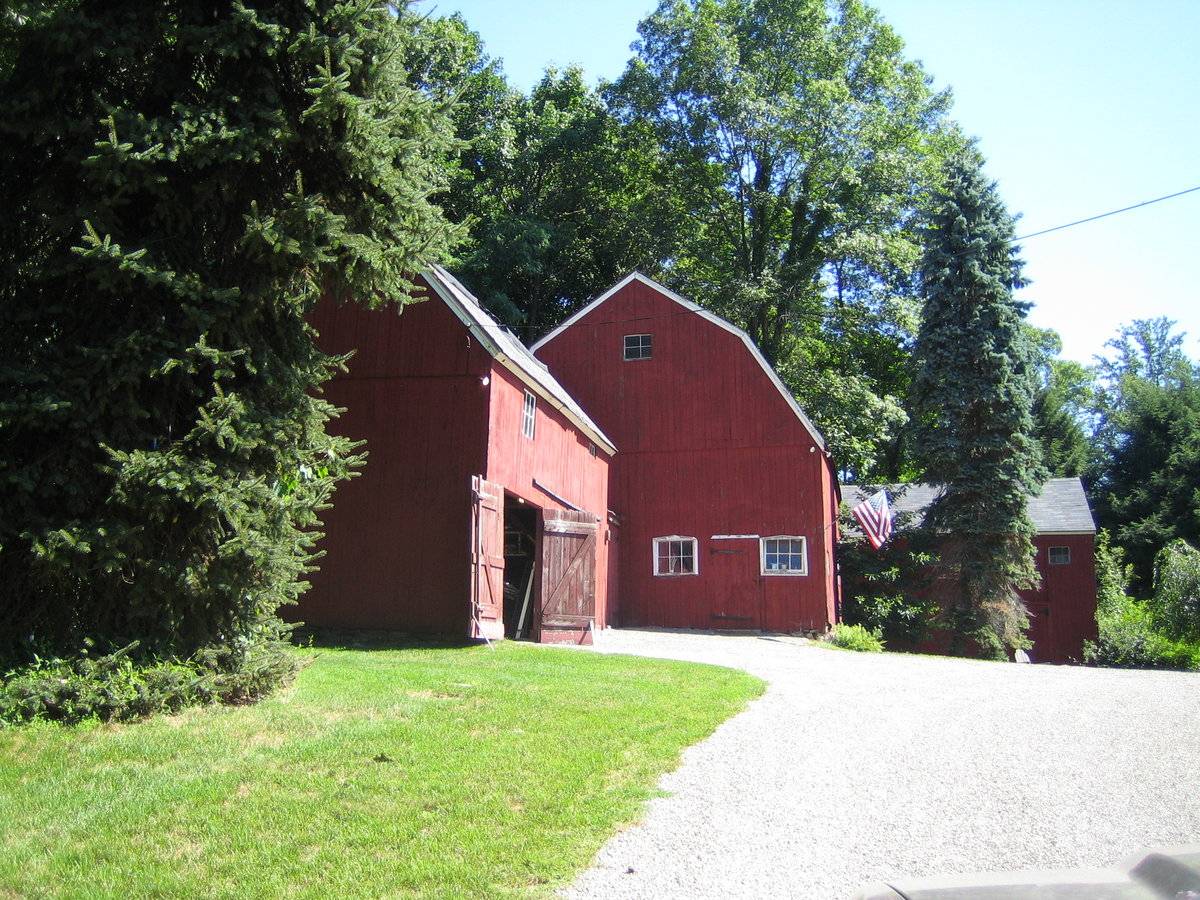
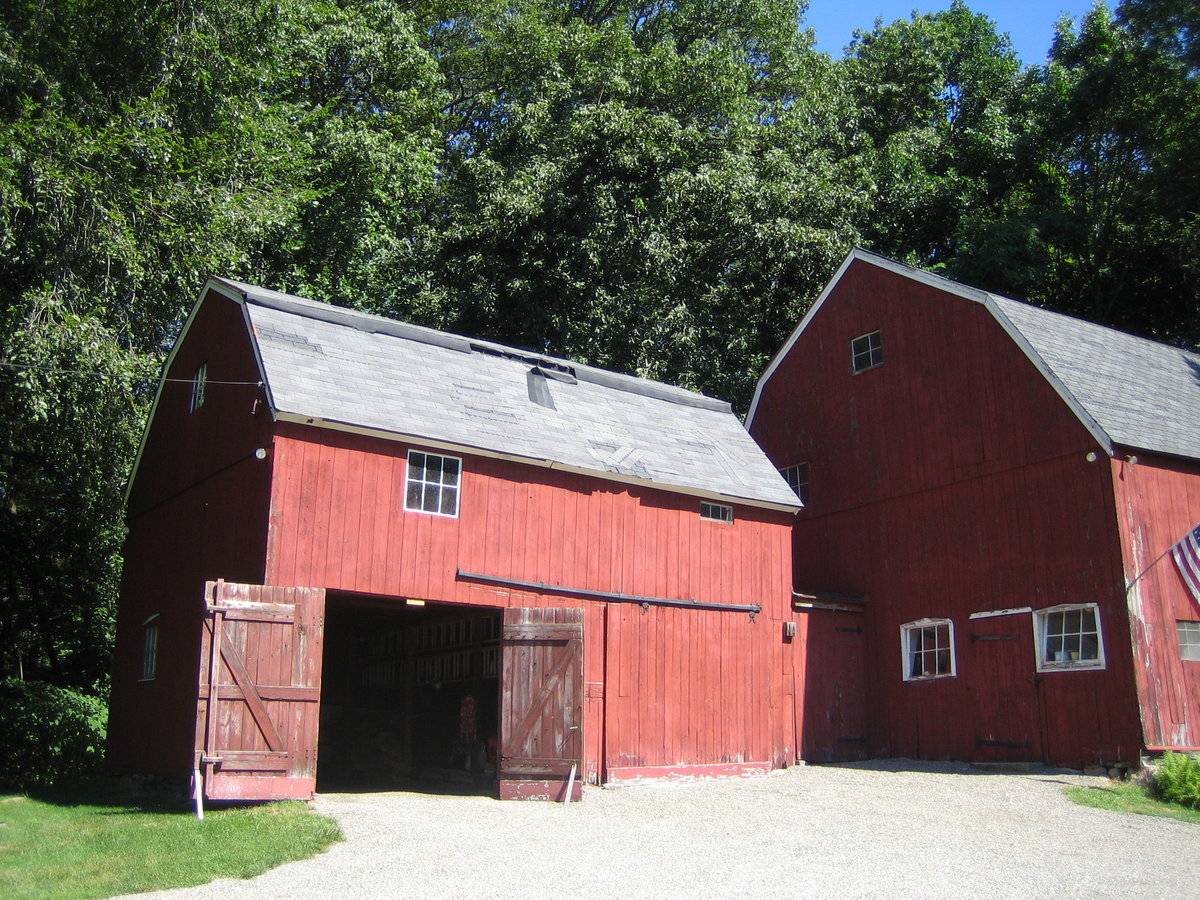
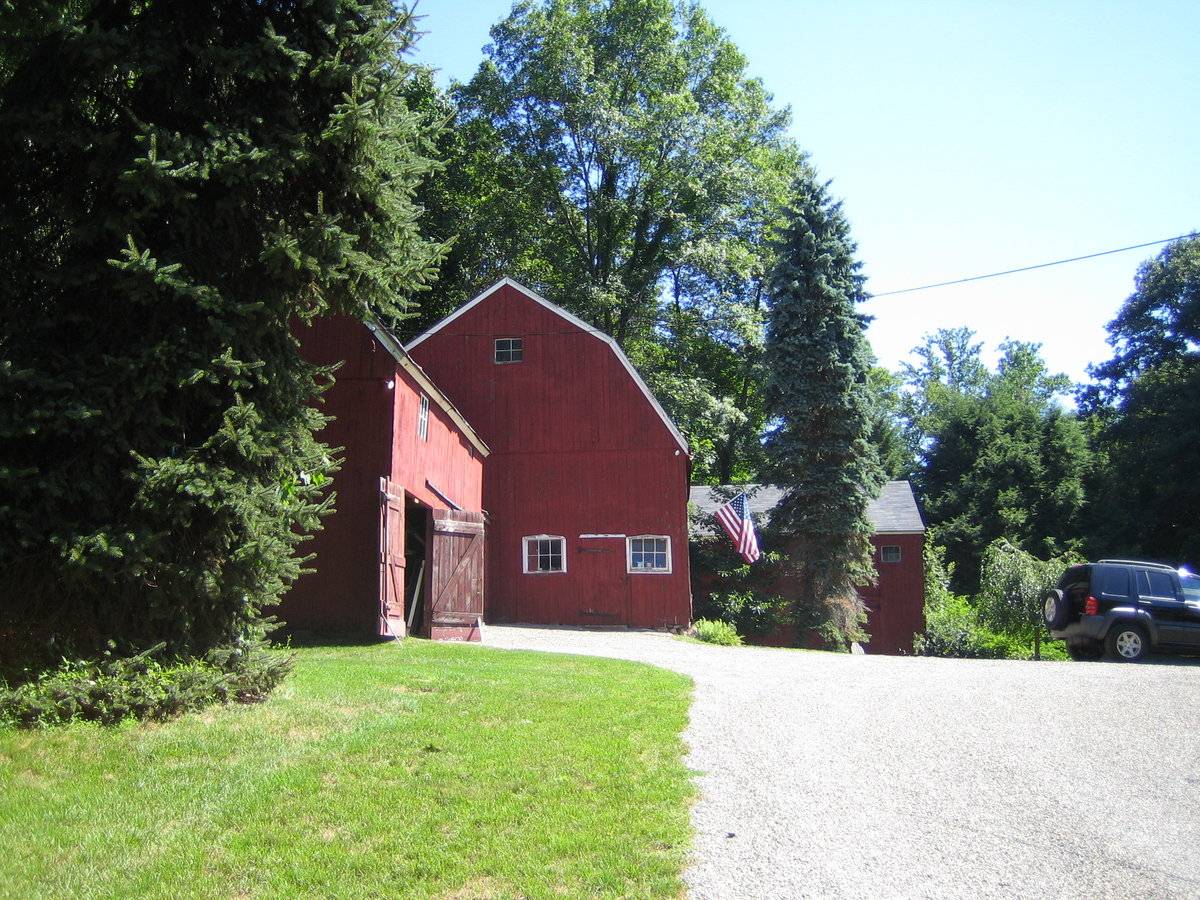
The original structure is a 1 1/2-story eave-entry barn with a gambrel-roof. The main facade faces west with the ridge-line running perpendicular to this portion of Burr Road, which runs northwest to southeast. The barn appears to have two barn additions, the first is set end-to-end but offset to the north of the main barn. The first addition (Addition I), a 1-story gambrel-roof barn, is connected by a passageway from the barn and extends off the west gable-end. The second addition (Addition II) extends off the east corner of the south eave-facade of the barn and is a 1-story gable-roof barn with the ridge-line perpendicular to that of the main barn. The main entry of the original barn has since been moved to Addition I.
The main entry is located on the south eave-side of Addition I and consists of a pair of sliding doors with an exterior track in the east corner and a pair of swinging hinged doors in the west corner. On the second floor above the swinging hinged doors is a fixed six-pane window and above the sliding doors is a fixed three-pane transom. On the west gable-end of Addition I, the grade drops off revealing a portion of the stone foundation. There appears to be a fixed six-pane window with trim on the first floor and another fixed six-pane window in the gable attic.
The west gable-end of the barn, the main facade, consists of a swinging hinged door located toward the south corner. A six-pane awning window with trim is located on either side of the door. There is a fixed six-pane window on the second floor toward the north corner and a fixed-four pane window in the gable attic of the west gable-end of the main barn. On the west gable-end the grade drops off to either side of the swinging hinged door revealing a portion of the stone foundation. There appears to be two window openings on the south eave-side, including a fixed six-pane window toward the west corner.
Addition II appears to be situated down a slope from the original barn and first addition. The main entry appears to be located on the west eave-side and is a double or single leaf swinging hinged door located toward the south corner.
The original barn and Addition I are clad with vertical siding painted red. The roof of the original barn and Addition I are clad in asphalt shingles.
Historical significance:The gambrel roof design was universally accepted for ground-level stable barns as it enclosed a much greater volume than a gable roof did, and its shape could be formed with trusses that did not require cross beams, which would interfere with the movement and storage of hay. Also known as the curb roof, the double slopes of the gambrel offer more volume in the hayloft without increasing the height of the side walls.
The tobacco barn, or shed as it is called in the Connecticut River Valley, is one of the most distinctive of the single-crop barns. They tend to be long, low windowless buildings with pitched roofs. They are characterized by vented sides and roofs to regulate air flow and allow harvested tobacco to cure at the appropriate rate. Derived initially from the design of the English barn, the shed is composed of a fixed skeleton consisting of two- or three-aisle bents repeated at intervals of 15 feet to the desired length. The wood-framed bents sit on piers of stone or concrete and the bents are connected by girts and diagonal braces. Typically there are one or two door openings at each end, making the shed a “drive-through,” although some sheds are accessed through doors on the sides. The interior structural framework serves a second purpose in addition to supporting the walls and roof of the building; it provides a framework for the rails used to hang the tobacco as it cures.
Field Notes
n/a
- Use & Accessibility
- Environment
Related features
Environment features
Relationship to surroundings
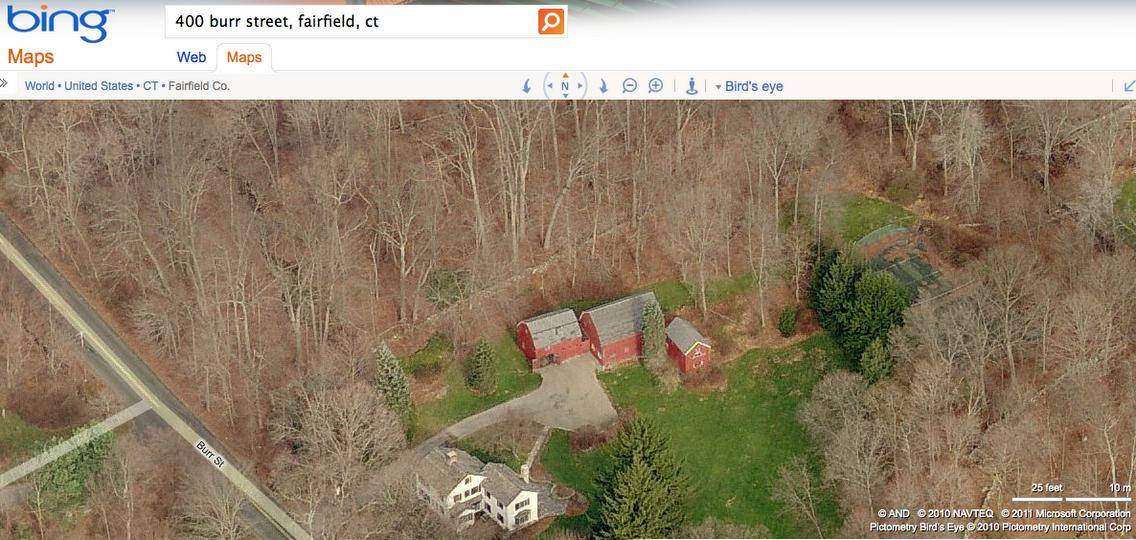
The barn with two additions is to the northeast side of the ca. 1764 house it is associated with. There is a tennis court to the northeast of the house and barn. The ridge-line of the house is perpendicular with the ridge-line of the barn and the first addition and perpendicular with the barn’s second addition. A driveway to the west and northeast of the house leads from Burr Road to the barn. There are stone walls running through the woods just beyond the cleared area of the site, from the west-northwest to the northeast and from south-southwest to the east of the house. The site is mostly landscaped. The total size of the site is 3.20 acres. Much of the area surrounding the site is composed of residential suburbs and woodland.
Map 150, Vol. 1.
- Typology & Materials
-
Building Typology
Materials
Structural System
n/a
Roof materials
Roof type
Approximate Dimensions
Barn: 594 square feet, Addition I: 962 square feet, Addition II: 360 square feet.
- Source
-
Date Compiled
04/03/2011
Compiled By
K. Jefferson & T. Levine; reviewed by CT Trust
Sources
Field notes and photographs by Lynn Friedman 08/24/2006.
Town of Fairfield Assessor’s Record: http://data.visionappraisal.com/FairfieldCT/DEFAULT.asp
Parcel ID: 150/ 1/ / / /Aerial Mapping:
http://www.bing.com/maps accessed 4/03/2011.Sexton, James, PhD, Survey Narrative of the Connecticut Barn, Connecticut Trust for Historic Preservation, Hamden, CT, 2005, http://www.connecticutbarns.org/history.
Visser, Thomas D., Field Guide to New England Barns and Farm Buildings, University Press of New England, 1997.
- PhotosClick on image to view full file
-